| ||
An evaluation or assessment of an organisation's performance needs to be undertaken in order to ensure that the objectives of that organisation are being met. It does not matter whether the objectives are long, mid or short-term, there is no point in setting objectives if you do not intend to measure whether they have been successfully met. Such as assessment of performance will measure the effectiveness of the organisation. In addition, the way that the organisation employs and uses its resources to achieve these goals and objectives must be evaluated to see whether these resources are being used to their optimum capacity. Such an assessment of the organisation's performance will measure the efficiency of the organisation's operations. In addition to measuring the performance of the organisation as a whole, the performance of individual employees or teams of employees may be measured, as well as the performance of sections or departments of the organisation. Such evaluations will be carried out for different purposes.
There are three stages to the evaluation of organisational performance. Firstly, we need to know WHAT it is we intend to measure the performance of, i.e. the indicators or the criteria. Secondly, we need to know HOW we intend to measure these indicators or criteria. Thirdly, we need to establish what we intend to do with the outcomes of the evaluation process.
Organisations will look at their principal objectives, their core functions, and the key elements of their policies, then prioritise the key indicators or key result areas that they want to measure. Next, a specific criterion, measure or indicator will need to be established. These indicators will either be quantitative or qualitative in nature. Quantitative indicators are 'objective', as they measure aspects of performance that are quantifiable and are not subject to variation once they have been defined, e.g. the number of employees, the level of profit, the number of industrial accidents, the number of customer complaints. Qualitative indicators are, on the other hand, subjective in nature and vary according to who is providing the information, e.g. the level of customer satisfaction, the level of employee satisfaction, or the level of customer service. Organisations will select a number of key performance indicators (KPIs) to measure the key objectives or elements of organisational policy. Next, the organisation must decide how the data will be collected, i.e. the method that will be used. A number of options exist - statistical research, survey, observation, questionnaire, and benchmarking. An organisation may use a variety of methods to collect the necessary data that needs to be analysed.
|

EDUCATE YOURSELF
Saturday, 13 July 2013
Evaluaton of organisational performance


BUSINESS ENVIRONMENT
| |
Large-scale organisations do not operate within a vacuum, they operate within constantly changing commercial and non-commercial environments.
These organisations are not static, they are dynamic organisations operating within an open (as opposed to a closed) system.
It is important for managers within these organisations to understand the environment within which they operate so that they can be about any likely impacts that the environment may have on the organisation. In this way managers can make any necessary changes to ensure the continued success of the organisation and the attainment of its goals and objectives.
Large-scale organisations operate within essentially two broad environments - the internal environment and the external environment. The external environment may be further divided into the task environment and the general environment.
There are three major sectors or contributors to the internal environment which may impact on the organisation - management, employees and the culture of the organisations.
Management obviously has a significant impact on the way that the organisation operates and functions, through the management functions already discussed. The employees may impact on the organisation through the tasks that they perform and the way that they execute those tasks.
The culture of the organisation is a significant impactor as it incorporates 'the way that things are done within the organisation'.
The culture of the organisation includes the 'system of shared values' inherent within the organisation, i.e. what people both within and outside the organisation believe the organisation stands for and how it operates, e.g. the quality of its service and the level of the organisation's employee relations. If the culture was to alter then the operations of the organisation would change as well. It is worth noting that the organisation has a fair degree of control over these sectors and the impact that they have on the organisation.
|
Contributions of large-scale organisations to the economy
Large-scale organisations make a significant contribution to the economy as a whole and it is for this reason that governments take a special interest in the successful operation of these organisations
The main significant contributions that these organisations make include:
|
Specific management functions
- Marketing and Public Relations - managers must ensure that the right products and services are produced in the right style, at the right time for the right consumers, and to satisfy all consumer complaints if the organisation is to be successful
- Banking and Finance - managers must ensure that the organisation has the necessary financial resources to achieve its objectives and then they must control these organisational finances
- General Administration - managers must ensure that all the necessary paperwork, data entry and analysis are completed in the most efficient manner
- Distribution - managers must ensure that the products are delivered on time to customers and that delivery charges are kept to a minimum
HUMAN RESOURSES
- Recruit
- Select
- Appoint
- Induct
- Train
- Motivate
OPERATION MANAGER
He should be able to Plan, Execute in all Phase of Manufacturing or Service Provision
POLC CCM
There is a wide range of essential functions that must be performed by managers in large-scale organisations. These functions may be categorized into two broad types - generic functions and specific functions


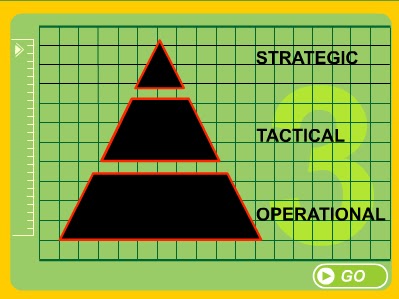
- Planning - managers must perform the task of planning at their designated level
- Strategic Level,
- Tactical Level or
- Operational level everything that the organisation must do to achieve its objectives, i.e. the long-term, the mid-term and the short-term plans
- Organising - managers must ensure that all of the necessary resources, i.e.
- Natural resources
- Human resources,
- Capital resources and
- Entrepreneurial or 'street smart' resources are available and are able to be used to perform the required tasks or for the required purposes so that the service can be provided or the product manufactured

- Leading - managers must lead the way for employees, customers and competitors; they must be at the forefront of trends and fashions and lead by example in the workplace through their technical skill and competencies
- Controlling - managers must perform a supervisory and control function to ensure that work is performed to the optimal level and that the quality of service provision of product manufacture is at world's best practice level
Distinguishing large-scale organisations
There are many ways that large-scale organisations can be classified and a variety of forms which they may take. The main way of distinguishing between large-scale organisations is by the ownership of the entity and its principal form of operation. Hence, we are able to distinguish between
government (public sector) and
non-government (private sector) organisations or,
put in another way, between publicly owned and privately owned organisations.
By 'publicly owned' we mean that the community as a whole owns the organisation and that it is operated on their behalf by the government.
Public sector or government organisations may in turn be categorized into three distinct forms -
General government entities, providing non-market goods and services (e.g. roads, hospitals and the like),
Public trading enterprises, providing market goods and services which meet their community service obligation and finally,
Public financial enterprises providing financial services e.g. government, banks and insurance offices.
Next, we can distinguish between those large-scale organisations which have as their primary or core objective, the
'profit motive', and those which are nonprofit oriented.
Also, We can distinguish between large-scale organisations according to the industry to which they belong -
primary, secondary or tertiary, or as to whether their core function is manufacturing or service provision.
We could also distinguish between
organisations according to their legal status and the extent of their legal liability (e.g
1.Sole trader,
2.Partnership,
3.Company,
4.Statutory authority,
5.Government department, and those large-scale organisations which have limited and those which have unlimited liability), and their size in terms of the number of employees, production levels and turnover.
Characteristics of large scale organisations
Characteristics of large scale organisations
|
So what is a large-scale organisation?Business enterprises can be classified according to certain characteristics.
There are a number of characteristics that may be used to classify a business enterprise as a large-scale organisation rather than as a small or a medium business enterprise.
The following characteristics may be used as a basis of such a classification. Before we attempt this classification, however, we should recall the basic rules of classification - exhaustiveness and exclusivity. The organisations we are attempting to classify as either small, medium or large-scale must all be able to be placed in at least one of the three categories (exhaustiveness) and the organisation being classified must be placed in one, and only one, of the categories (exclusivity).
If we take these characteristics and apply them to a large-scale enterprise then the following will normally be true. However, not all large-scale organisations will necessarily exhibit all of the following characteristics:
- HOW MANY STAFFS WORK IN THE ORGANISATION.
- WHAT IS THE ANNUAL TURNOVER/REVENUE OF THE COMPANY.
- WHAT IS THE VALUE OF THE COMPANY ASSETS.
- HOW MANY LOCATION DOES THE ENTERPRISES OPERATION FROM.
- HOW MANY OWNER ARE THERE IN THE COMPANY.
- WHAT IS THE RELATIONSHIP BETWEEN THE OWNER AND MANAGEMENT OF THE COMPANY.
Subscribe to:
Posts (Atom)